8 months ago
3 minutes Read
Vikramasila University – The University of Gatekeepers of Knowledge - Unique Admission System – The Dvar-Pandits
Introduction
Vikramasila University was established in the 8th century CE by King Dharmapala of the Pala dynasty in eastern India. It soon became one of the greatest Buddhist learning centres in the world, especially known for philosophy and logic studies.
Vikramasila University was one of the greatest centres of higher learning in ancient India. It gained fame within a short period after its establishment and became an international destination for scholars and monks.Unlike many institutions of its time, Vikramasila was a fully residential university surrounded by strong protective walls. The campus maintained discipline, intellectual debate, and a structured education system guided by highly learned teachers and philosophers.
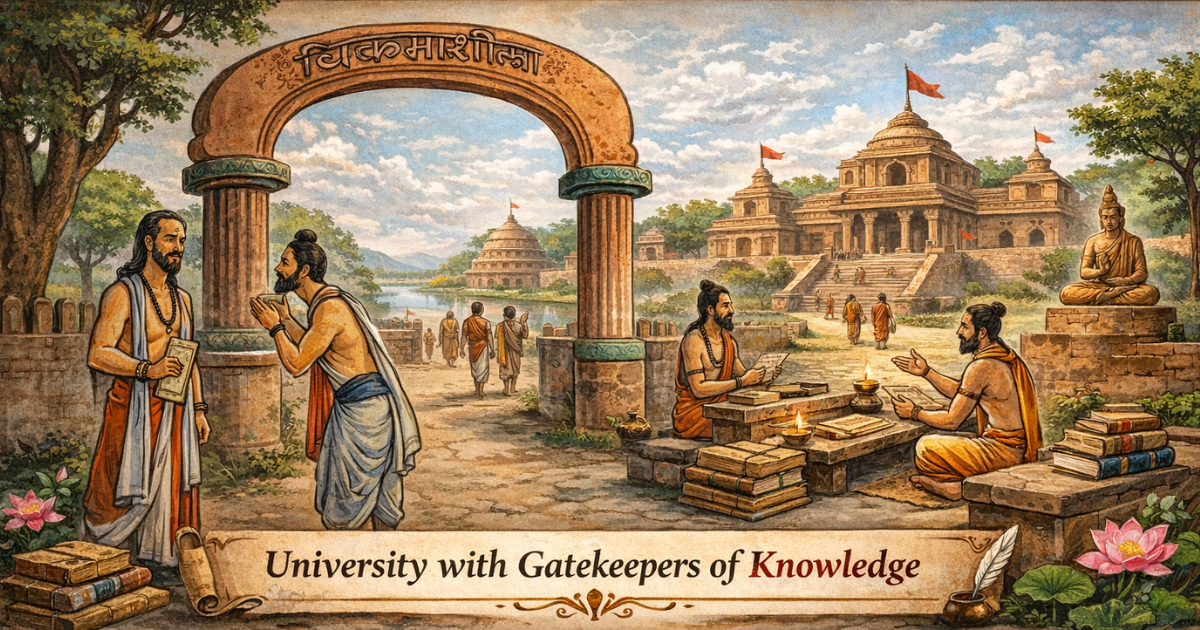
University with Gatekeepers of Knowledge
Vikramasila became a very famous University within a short time of its establishment. It was a residential University enclosed by a strong wall. The teachers at Vikramasila were very learned and philosophers of a higher order. The entrance examination for admission was conducted at the University's gateways by the guards of knowledge, known as Dvar-Pandits. A Governing Board, headed by the learned monk, was managing the administration of Vikramasila, and teaching work was under the control of a board of eminent scholars.
Unique Admission System – The Dvar-Pandits
One of the most remarkable features of Vikramasila was its strict admission process.
Students could not enter directly into the university.At the gates, highly knowledgeable scholars known as Dvar-Pandits (Gatekeepers of Knowledge) conducted entrance examinations. Only students who demonstrated deep understanding and intellectual ability were allowed to study inside. This system ensured that Vikramasila remained a centre of serious academic excellence.
Administration & Teaching Structure
The university was carefully organized:
-
A Governing Board led by a senior monk managed administration
-
A Council of eminent scholars supervised teaching
-
Teachers were respected philosophers and spiritual masters
-
Students lived and studied within the campus
This created an environment of discipline, research, and spiritual learning.
Subjects & Courses
Vikramasila specialized in advanced intellectual studies, especially Buddhist philosophy and logic.
Major subjects included:
-
Logic (Nyaya)
-
Grammar
-
Tantra Studies
-
Philosophy
The focus was not only memorization but deep reasoning, debate, and understanding.
Renowned Teachers & Students
Many great scholars studied and taught here, including:
Atish, Sribhadra, Dipamkar, Ratnavraj, Rantakeerti, Ratnakarshanti, Vaqishwarkeerti, Buddha Gnanpad, and Abhayankar Gupt Dharmakeerti.
These scholars later spread knowledge across Asia, showing the global importance of Vikramasila University.
Educational Importance
Vikramasila shows that ancient India valued:
-
Entrance testing based on knowledge
-
Residential campus learning
-
Debate and philosophy
-
Teacher-guided mentorship
-
Discipline and intellectual growth
The university focused on building thinkers, not just degree holders.
Final Thoughts – Learning Then and Now
Ancient universities like Vikramasila prove that education in India always aimed at curiosity, discipline, and practical wisdom rather than only textbooks.
At Summer Camp India, we follow a similar philosophy — encouraging children to learn through exploration, questioning, discussion, and real-world activities instead of rote memorization.
By understanding how students learned in ancient universities, children today can appreciate learning as an exciting journey rather than a burden.
Education becomes meaningful when it builds thinking, creativity, and confidence — the same values that guided students of Vikramasila centuries ago and continue to inspire young learners today.
Would you like the Article?
Share this Article to Social Media
Recent Blogs