7 months ago
2 minutes Read
Ayodhya: A Multidisciplinary Centre of Learning in Ancient Bharat
The significance of Ayodhya extends far beyond its sacred identity as the birthplace of Lord Rama. In classical Indian tradition, Ayodhya is counted among the Sapta Puri — the seven sacred cities associated with spiritual emancipation. Yet, its importance was not limited to spiritual heritage alone. Ayodhya also functioned as a vibrant centre of learning, discipline and philosophical inquiry.
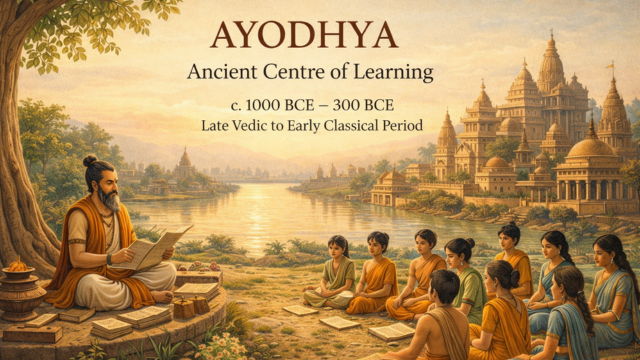
Across different periods, the region surrounding Ayodhya was home to numerous ashrams and educational centres where various schools of thought flourished. These Gurukul institutions did not merely transmit scriptural knowledge; they cultivated intellectual, moral and practical training in an integrated manner.
One of the most well-known traditional references is Maharshi Vasistha, revered as the royal preceptor of Lord Rama. His ashram is traditionally associated with the Ayodhya region and is remembered as a place where disciplined education and character formation were central to learning.
Education in such ashrams was structured yet egalitarian in spirit. Historical and traditional accounts describe a system in which princes and ordinary students lived under the same discipline. There was no distinction in daily routine, responsibilities or training. All students followed a common lifestyle rooted in simplicity, self-regulation and service.
Importantly, women’s participation in learning traditions is acknowledged in various classical texts. Across ancient Bharat, learned women such as Gargi and Maitreyi engaged in philosophical discourse, indicating that education, though shaped by social contexts of different periods, was not conceptually limited to one gender.
Training within these ashrams was multidimensional. Students were instructed not only in scriptural studies but also in practical disciplines. The curriculum often included:
-
Vedic studies and philosophy
-
Ethics and moral reasoning
-
Language and grammar
-
Martial training and physical discipline
-
Statecraft and administrative principles
-
Ritual sciences and social responsibilities
Learning was not confined to theory. Practical application, discipline of routine, service to the teacher, and character refinement formed the core of the educational process.
The Gurukul system emphasized that knowledge must transform conduct. Intellectual training was inseparable from lifestyle training. Students developed self-control, clarity of thought, resilience and responsibility — qualities considered essential for leadership and societal contribution.
Ayodhya, therefore, represents more than a sacred geography. It reflects a civilizational model where education was designed to cultivate balanced human beings — intellectually capable, morally grounded and socially responsible.
Would you like the Article?
Share this Article to Social Media
Recent Blogs