6 months ago
5 minutes Read
Rāmāyaṇa Era and Birth Date of Shri Rama: A Historical and Astronomical Perspective
Rāmāyaṇa Era and Birth Date of Shri Rama: A Historical and Astronomical Perspective
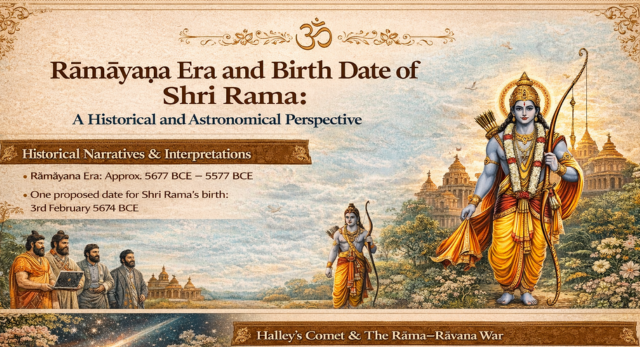
The timeline of the Rāmāyaṇa and the birth date of Shri Rama have long been a subject of discussion among historians, scholars, and astronomers. Based on traditional interpretations, the Rāmāyaṇa era is believed to fall between 5677 BCE and 5577 BCE, with one proposed birth date of Shri Rama being 3rd February 5674 BCE.
Understanding the Transformation of Historical Narratives
Over centuries, the original historical essence of the Rāmāyaṇa evolved through poetic storytelling. Sanskrit literature, rich in Adbhuta Rasa (sense of wonder), often introduced exaggerations that transformed historical accounts into historico-mythological narratives.
For instance, some texts mention extremely long lifespans such as 60,000 years for King Sagara and 11,000 years for Shri Rama. These are widely understood as symbolic rather than literal, reflecting literary expression rather than precise history.
Astronomical Methods to Determine Rama’s Birth Date
Modern researchers have attempted to calculate the birth date of Shri Rama using astronomical references found in the Vālmīki Rāmāyaṇa. These references include planetary positions, nakshatras, and celestial alignments.
Some of the prominent proposed dates are:
- Pushkar Bhatnagar – 10 January 5114 BCE
- P.V. Vartak – 4 December 7323 BCE
- Nilesh Oak – 29 November 12240 BCE
Although these dates differ, they highlight the strong presence of astronomical knowledge in ancient Indian texts.
Traditional Timeline and Yuga Framework
According to traditional beliefs, Shri Rama was born during the Tretā Yuga. Based on interpretations of ancient texts:
- Tretā Yuga is estimated between 6777 BCE and 5577 BCE
- The Rāmāyaṇa likely occurred toward the end of Tretā Yuga (5677–5577 BCE)
The Mahābhārata also supports this by referring to the Rāmāyaṇa as an event that took place during the closing phase of the Tretā Yuga.
Following this period, the Dvāpara Yuga is considered to span approximately from 5577 BCE to 3177 BCE, indicating a structured chronological framework in ancient Indian tradition.
Challenges in Puranic Interpretations
The Purāṇas introduce complex concepts such as multiple Vyāsas across different Yugas, which create interpretational challenges. For example, Vālmīki is described as a contemporary of Shri Rama, yet some traditions place him in a different Yuga.
Such inconsistencies suggest that certain Puranic narratives are symbolic or later interpretations, rather than strictly historical accounts. Therefore, distinguishing between tradition and historical evidence becomes essential.
Birth Details of Shri Rama in Valmiki Ramayana
The Vālmīki Rāmāyaṇa provides detailed astronomical conditions at the time of Shri Rama’s birth:
- Chaitra month, ninth day (Navami)
- Punarvasu Nakshatra
- Karkaṭa (Cancer) Lagna
- Five major planets in exalted positions
Additionally, the text records the birth details of his brothers:
- Bharata – Puṣya Nakshatra
- Lakshmana and Shatrughna – Āśleṣa Nakshatra
These precise observations form the foundation for astronomical dating studies.
Development of Ancient Indian Astronomy
Early Indian astronomy, particularly in Vedāṅga Jyotiṣa, focused mainly on determining auspicious timings (Muhūrta) for rituals. While knowledge of planets existed during the later Vedic period, their role in astrology developed gradually.
Significant early observations such as:
- Arundhati–Vasiṣṭha alignment (~10,000 BCE)
- Rohiṇī Śakaṭa Bheda (~9800–9300 BCE)
indicate that systematic astronomical understanding began evolving around 9000 BCE.
Halley’s Comet and the Rāmāyaṇa Timeline
One of the most interesting correlations is the appearance of Halley’s Comet (1P/Halley):
- Observed in Mūla Nakshatra around August 5635 BCE
- Visible to the naked eye for several days
Since Rāvaṇa is associated with Mūla Nakshatra, this celestial event is interpreted by some scholars as an astrological indication of the fall of Rāvaṇa.
Based on this observation, the Rāma–Rāvaṇa war is estimated around 5635 BCE, adding another dimension to the timeline of the Rāmāyaṇa.
Conclusion: A Blend of Tradition, Astronomy, and Interpretation
The study of the Rāmāyaṇa era and the birth of Shri Rama lies at the intersection of tradition, astronomy, and literary interpretation. While exact dates may differ across scholars, the consistency of astronomical references and traditional timelines highlights the depth of ancient Indian knowledge.
Note: This article is based on the research, interpretations, and original works of Sri Vedveer Arya, particularly his insights on the chronological discrepancies in Indian history. The content has been adapted and presented for educational and awareness purposes, and full credit goes to Sri Vedveer Arya for his extensive work in this field.
Would you like the Article?
Share this Article to Social Media
Recent Blogs